For solar asset owners, O&M and EPCs

Hundreds of acres of glass, tilted toward the sky

Hail damage to solar panels is the largest single-event risk a utility-scale plant carries. Trackers can stow out of the way — but only if someone decides to, before the storm. Where a Tessera stands on the array, Hailios measures the impact energy that lands on it. Hailios Fusion AI, trained on years of those measurements, covers the rest: it answers for any US site without a sensor, warns the control room up to 30 minutes ahead in time to stow, and afterward shows which parts of the site took the hit and on what date.

PV HAIL RISK · GROUND TRUTH, NOT RADAR INFERENCEMOUNT: ROOF · POLE · TRACKERANY US ADDRESS · ANY TESSERA SITE IN 150+ COUNTRIES

The exposure, plainly

One storm is the whole downside

A PV plant is an unusually exposed piece of infrastructure: it is glass, facing the sky, at a known tilt, spread flat across hundreds or thousands of acres with nothing above it. Fire, flood and wind are all survivable in patches. A severe hail swath is not a patch — it crosses the site in minutes and reaches every row it passes over, in the same posture, at the same time.

That makes hail the one peril capable of turning a producing asset into a total-loss-scale claim in a single afternoon, and it is why hail deductibles and sub-limits have become the hardest line to place on a solar program. Owners, O&M contractors, EPCs and the carriers behind them are all making decisions about the same event — usually from radar, which never stood on the site.

Solar tracker stow, and hail

Stow works. Deciding to stow is the hard part.

A tracker that rotates to a steep defensive angle changes the geometry of every impact on it. A stone falling on a flat module transfers its kinetic energy straight into the laminate. The same stone striking a steeply pitched face meets it obliquely: only part of the motion is into the glass, the rest carries along it, and the impact energy the module face has to absorb drops sharply. Nothing about the storm changes. The angle it hits does.

DETAIL K · STOWONE ROW · TWO POSTURES · SCALE NTSWORKING TILT · FULL FACE TO THE SKY IMPACT ENERGY ABSORBED: THE WHOLE BLOWSTOW COMMANDALERTS · UP TO 30 MINUTES AHEADBEFORE THE ICE ARRIVESSTOWED · STEEP · GLANCING BLOW TESSERA ON THE TUBETILTS WITH THE ROWMOST OF ITGOES PASTIMPACT ENERGY ABSORBED: A FRACTION
THE STOW DECISION, DRAWN. LEFT: THE MODULE FACE TAKES THE WHOLE BLOW. RIGHT: MOST OF IT GOES PAST. THE CATCH IS THAT YOU CHOOSE BEFORE THE ICE ARRIVES.

The error is expensive in both directions

STOW · STORM MISSES

You defended against a storm that went around you

Steep stow takes the array off production for the duration, and a cautious operator running a portfolio does it across sites that were never going to be hit. Every false stow is generation sold to nobody. Do it often enough and the O&M team stops trusting the trigger — which is the expensive part.

NO STOW · STORM HITS

You left the modules at working tilt and the ice arrived

Glass presented to the sky at the angle that collects the most impact energy per stone, across every row at once. The result is not a repair queue. It is a single-event claim, a curtailed plant, and a procurement problem measured in shipping containers of modules.

SO STOW ISN’T AN ENGINEERING PROBLEM. THE HARDWARE ALREADY ROTATES. IT’S A FORECASTING PROBLEM WITH A BILL ATTACHED TO BEING WRONG EITHER WAY.

Know what’s coming

Mosaic Alerts · the warning that arrives in time to stow

Alerts raises the warning when hail above your threshold is heading for your sites: up to 30 minutes ahead, tightening as the cell resolves. It does not tell you the future. It tells you when to take the array out of the way.

That is the missing input in the stow decision. A control room stowing on a public watch box is stowing on a county. A control room stowing on Alerts is stowing on a signal tied to the sites it actually covers. Hailios Fusion AI does the watching for every site, and where a Tessera stands on the array, it records what the storm actually delivered.

  • Ahead of the event — alerting to O&M, the control room and the on-call roster, per site.
  • Site-shaped, not county-shaped — the plants you operate, not a warning drawn around a whole county.
  • Answerable afterward — when it clears, Mosaic Reports shows what actually fell, so every alert can be checked against the event.

ALERTS · A WARNING LIGHT, NOT A CRYSTAL BALL

Stow validation

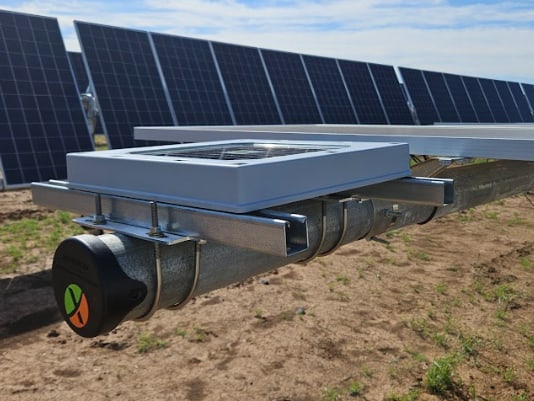
The third mount goes on the torque tube

Tessera mounts to the roof with adhesive pads, to a pole over a yard — and directly to the tracker torque tube. On the tube, the instrument rotates with the row: it sits at the same angle to the sky the modules do, through the working day and through the stow. That is what turns stow from a command you sent into a fact you can show — the row moved, at this time, and here is the impact energy it met once it got there.

Mount variantsRoof (peel-and-stick), pole, and tracker torque tube. One instrument, three ways to put it where the hail lands.
What it recordsImpact count, impact energy per strike, impact concentration and event duration — timestamped to the second.
Stone sizeA measured floor, never inflated, with the most likely size modeled beside it and labeled so.
Supporting dataTemperature, relative humidity and tilt angle. The instrument knows the weather it stands in, and the angle it stands at.
What it settlesWhether the row was at the angle you think it was, and what the module face actually took while it was there.

ROOF. POLE. TRACKER. — THE THIRD ONE ROTATES WITH THE ROW.

A Tessera sensor bracketed to the torque tube of a utility-scale solar tracker, rows of photovoltaic panels behind it under a blue sky
Mounted to the torque tube, out in the arraySAME TILT AS THE MODULES. SAME STORM. SAME SECOND.
Know the event

Mosaic Reports · which parts of the site took it, and on what date

The morning after is where solar hail claims go slowly. Damage that matters is often not visible from a truck: microcracks under the glass, cells degraded but still producing, modules that will fail their warranty curve two years from now. So the site gets walked, block by block, and the argument with the adjuster becomes an argument about whether each crack was hail, handling, or the way the module was shipped.

Reports starts from ground truth instead. One event, one date, one report: what fell over this plant, when it fell, how big it got and which parts of the site took it, measured where a Tessera stands and ground-trained by Hailios Fusion AI anywhere else in the US. Held against the hail rating the owner already has for those modules, it turns an acreage-wide opinion into a bounded question — and it gives the carrier the same document the owner has, which is usually what shortens the conversation.

Parametric partners working with our data
  • AXA Climate
  • Covermetrics
  • Descartes Underwriting
  • Hailsure
  • Liberty Mutual Re
  • Mainstay Underwriting
  • MSI Guaranteed Weather
  • Munich Re
  • Swiss Re
  • XS Global

Everything above happens after the site exists. Mosaic Risk sits in front of it. Hail hazard, scored across the US: six years of hail that was measured where it fell, set against 26+ years of reported record — so a development pipeline can be ranked before land is optioned, and an insurability question can be asked while it is still cheap to answer.

It gives you a layer to put in front of the underwriters and cat modelers on the other side of your program, so the negotiation is about a shared number rather than two competing guesses. Measured where we are, ground-trained where we aren’t, and always labeled accordingly.

Know the risk

Mosaic Risk · at the front of the asset lifecycle

SITE SELECTION · INSURABILITY · PORTFOLIO HAZARD — ASKED BEFORE THE FIRST PILE GOES IN, NOT AFTER THE FIRST CLAIM GOES OUT.

Talk to us

Stow in time. Then know what hit, and where.

Tell us where your plants are, what your trackers stow to, and who carries the hail layer. We’ll show you what ground truth changes about the stow call, and about the record afterward: what fell, when, and which parts of the site took it.

ASSET OWNERS · O&M · EPCS · A FRIENDLY REPLY FROM A REAL PERSON, USUALLY THE SAME DAY.

Talk to us
Stow in time. Then know what hit, and where.